What Pool Chemicals Do to Your Concrete Pool Deck Over Time
Most Jacksonville homeowners stay on top of pool water chemistry because the consequences of neglecting it are immediate and obvious: cloudy water, algae blooms, equipment corrosion. What's less obvious is what those same chemicals are doing to the concrete surrounding the pool. The damage happens slowly, in layers, and rarely announces itself until it's already significant.
Chlorine, pH adjusters, algaecides, and shock treatments are designed to work on water chemistry. When they splash, drip, or drift onto your pool deck, they're working on something else: breaking down the protective sealer, etching into the surface paste of the concrete, and weakening the material that's supposed to hold up under years of bare feet, Florida sun, and Northeast Florida downpours. Understanding the process makes maintenance decisions easier, and a lot cheaper in the long run.
What Pool Chemical Exposure Actually Does to Concrete
Pool chemicals (primarily chlorine and pH-adjusting acids) attack concrete in two stages. First, they can degrade the sealer on the surface, removing the barrier that protects against moisture and UV. Second, repeated direct contact etches into the concrete paste itself, softening and pitting the surface at a microscopic level that accelerates wear under foot traffic and Florida weather. Once the sealer is gone, there is nothing slowing that process down.
The paste layer (the smooth, finished surface of concrete) is what most people stand on, walk across, and see. It's also the most vulnerable part of the slab to chemical exposure. Chlorinated splash from pool entry and exit, overflow during heavy rain events, and chemical drips during treatment create repeated exposures that are most concentrated in specific zones near the pool edge, steps, and deck drains.
pH fluctuation amplifies the damage. Most pool owners know to keep pH between 7.2 and 7.8. When it drops below that range, the water becomes more acidic, and acidic water sitting on or splashing across concrete actively etches the surface. Muriatic acid, sometimes used to correct pH imbalances or clean pool tile, is particularly aggressive on bare or under-sealed concrete and should never contact the deck without protection in place.
Calcium hypochlorite shock, the granular form of shock treatment, is another concentrated source of chemical contact. Spilled granules that sit on the deck before being swept up leave white bleach marks, pitting, and accelerated surface breakdown in those spots. Over time, the cumulative effect of repeated small exposures adds up in ways that become hard to reverse.
Why Jacksonville Pool Decks Are More Vulnerable
Jacksonville's combination of heat, UV intensity, and a longer pool season means chemical exposure is more frequent and its cumulative effects can be more pronounced than in cooler climates. Pools here often run year-round or close to it, which means the total annual contact with chlorine, acids, and shock treatments is significantly higher than the national average. Florida sun breaks down sealer faster than average, so the window before bare concrete is exposed is shorter without consistent maintenance.
A Jacksonville pool that's in active use from April through October, which describes the majority of residential pools here, accumulates a significant amount of chemical contact over a single year. Every jump into the pool, every automatic chlorinator cycle, every heavy rain that sends pool water across the deck: that's chemical contact on your concrete.
UV exposure compounds everything. Jacksonville's sun is intense year-round, and summer UV levels will degrade an unsealed or thinly-sealed surface faster than most homeowners expect. Sealer breaks down under UV exposure, which means chemical contact reaches bare concrete sooner if the deck hasn't been maintained consistently. Sandy soils common throughout many Jacksonville neighborhoods also affect drainage. Areas where water pools or drains slowly see more sustained chemical exposure than well-drained sections of the same deck.
From a field perspective, older pool neighborhoods tell the story clearly. In parts of Mandarin, San Marco, and Southside with pools from the 1980s and 1990s, it's common to see pool decks that haven't been professionally cleaned or resealed in many years. Surfaces that have gone from smooth and solid to rough, porous, and visibly degraded. That texture change is not just cosmetic. Rough concrete holds algae, mold, and mildew more easily, gets hotter underfoot in summer, and deteriorates faster once the surface paste layer is gone.
What Happens When Chemical Damage Goes Unaddressed
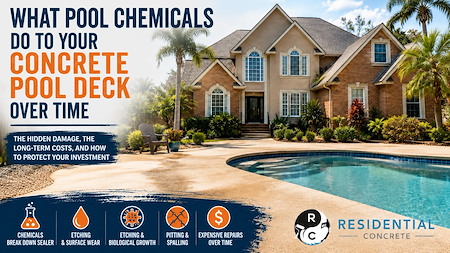
Untreated chemical damage follows a predictable progression: sealer degrades, the surface turns porous, staining and biological growth take hold, and the concrete begins to spall and pit. What starts as surface discoloration eventually becomes rough texture, then visible flaking, then active structural deterioration. Catching and addressing chemical damage early costs far less than resurfacing or replacing a slab that has been neglected for years.
Once the sealer layer is gone, pool chemicals have direct access to the concrete. That's when real degradation accelerates. Chlorine and acidic compounds penetrate the pore structure, weakening the paste layer at a microscopic level that becomes visible over time. Foot traffic speeds the breakdown. Every step on an unprotected, chemically weakened surface grinds away more material.
Staining follows quickly. Without a sealer barrier, concrete absorbs everything it contacts: mineral deposits from pool water, algae, mildew, iron from fertilizer overspray, and tannin staining from tree debris near pool enclosures. These stains indicate an open, porous surface actively taking in whatever lands on it, not just a cosmetic issue.
Spalling, where the surface layer begins to flake or chip off in sections, signals that chemical degradation has progressed well beyond surface-level wear. At that point, the deck isn't just unsightly. The rough, uneven texture becomes a safety concern for bare feet, and the exposed aggregate underneath will continue to deteriorate faster than the original finished surface did.
How Maintenance Slows Chemical Damage
The most effective protection against pool chemical damage is maintaining an intact sealer layer combined with regular professional cleaning. A well-applied sealer creates a barrier that chemical splash must work through before reaching the concrete. Professional washing removes chemical residue, mineral deposits, and biological growth before they penetrate or stain. Together, these two steps extend the life of any pool deck significantly, and cost a fraction of resurfacing or replacement.
Pool deck sealing protects the surface by creating a barrier between pool chemicals and the concrete underneath. Most pool decks in Jacksonville need resealing every 3–5+ years, but that window can shorten considerably without regular cleaning in between. Chemical residue and biological growth left sitting on a thinly-sealed or unsealed surface accelerate the breakdown of whatever protection remains.
Professional pool deck washing is the maintenance step most homeowners skip. It removes mineral deposits, algae, mold, mildew, and surface staining before they set in. Having the deck cleaned once or twice a year, gives the sealer a clean, sound substrate to bond to, which directly affects how long the protection lasts and how well it performs.
When chemical damage has already progressed past what cleaning and resealing can address, pool deck resurfacing restores the surface layer without removing the slab. Resurfacing covers spalled, pitted, or etched areas with a fresh top coat that gives the deck a sound surface to build on again. For decks with isolated damage, pitting around the pool edge or concentrated staining in heavy-splash zones, targeted pool deck repair can address specific problem areas before they spread.
Signs Your Pool Deck Is Showing Chemical Damage
Chemical damage to pool deck concrete shows up in predictable ways: white mineral deposits along the pool edge and coping, rough or gritty texture where the surface was once smooth, staining that doesn't wash off with standard cleaning, and small pits or craters in areas closest to pool entry points. Flaking or scaling of the surface layer is a sign that damage has progressed beyond cosmetic and is worth addressing promptly.
Signs to watch for:
- White or gray mineral deposits along the waterline or coping edge. These are calcium and mineral buildup from sustained pool water contact. Concentrated in areas that see the most splash and overflow.
- Surface roughness in zones near pool steps and entry points. Run your hand across an older section near the pool edge versus a protected section away from the water. The difference in texture is noticeable on decks that haven't been maintained.
- Staining that doesn't respond to basic cleaning. Particularly around pool drains, near chemical storage areas, and in corners where water collects and sits.
- Small craters or pits in the surface. Most visible in early morning or late afternoon light when the sun crosses the deck at a low angle. The shadows make surface irregularities easy to spot.
- Flaking or scaling of the top surface layer. Early-stage spalling will accelerate without intervention. If you can see or feel areas where the surface is beginning to separate or chip, that's past the point of simple cleaning.
- Persistent dark growth in surface pores. Algae, mold, and mildew establish more readily in chemically damaged, porous concrete than on well-sealed surfaces. Growth that keeps returning in the same spots is often a sign of underlying surface damage rather than a cleaning problem alone.
Frequently Asked Questions
Most pool decks in Jacksonville need resealing every 3–5+ years, depending on chemical splash exposure, sun intensity, and whether the deck has been professionally cleaned between seal applications. Decks near heavy-use entry points or with high chemical volumes may need attention on the shorter end of that range. A professional inspection gives you a clearer picture of where your specific surface stands.
Mild mineral deposits sometimes respond to consumer-grade cleaners, but most chemical staining on concrete benefits from professional cleaning. Aggressive DIY cleaning, especially with acid-based products, can worsen the problem on an already-compromised surface. A professional pool deck wash removes residue without damaging the sealer or further etching bare concrete.
Very likely, yes. White spotting is typically mineral deposit buildup from chlorinated water contact. Surface roughness indicates the concrete paste layer has been worn down, usually a combination of chemical exposure, UV degradation of the sealer, and foot traffic on an under-sealed surface. A professional assessment will tell you whether the damage has progressed far enough to warrant resurfacing or whether cleaning and resealing will address it adequately.
A quality sealer applied to a properly prepared surface provides meaningful protection against chemical exposure, but it's not permanent. Sealer degrades under UV, traffic, and chemical contact over time, which is why the maintenance cycle matters. Letting sealer wear completely through before reapplying means chemical exposure reaches bare concrete, which is harder and more expensive to recover from than staying on a consistent schedule.
It can be. A rougher surface provides grip when wet, which is beneficial. But heavily textured, spalled, or pitted concrete can also cut bare feet, trap algae and mildew that become slippery, and harbor debris. Once spalling progresses to uneven aggregate exposure or sharp edges, it's worth having the surface evaluated for resurfacing.
See signs of chemical damage on your pool deck? Get a free evaluation.
If your pool deck is showing signs of chemical wear (rough texture, mineral staining, surface pitting, or visible flaking), the right time to address it is before the damage compounds further. Residential Concrete provides free evaluations for pool deck sealing, washing, resurfacing, and repair throughout Jacksonville and Northeast Florida.
Call us at 904-364-7153 or use the Contact Us button to schedule an inspection. We'll tell you exactly what the surface needs, nothing more, nothing less. Contact Us.
Contact Us