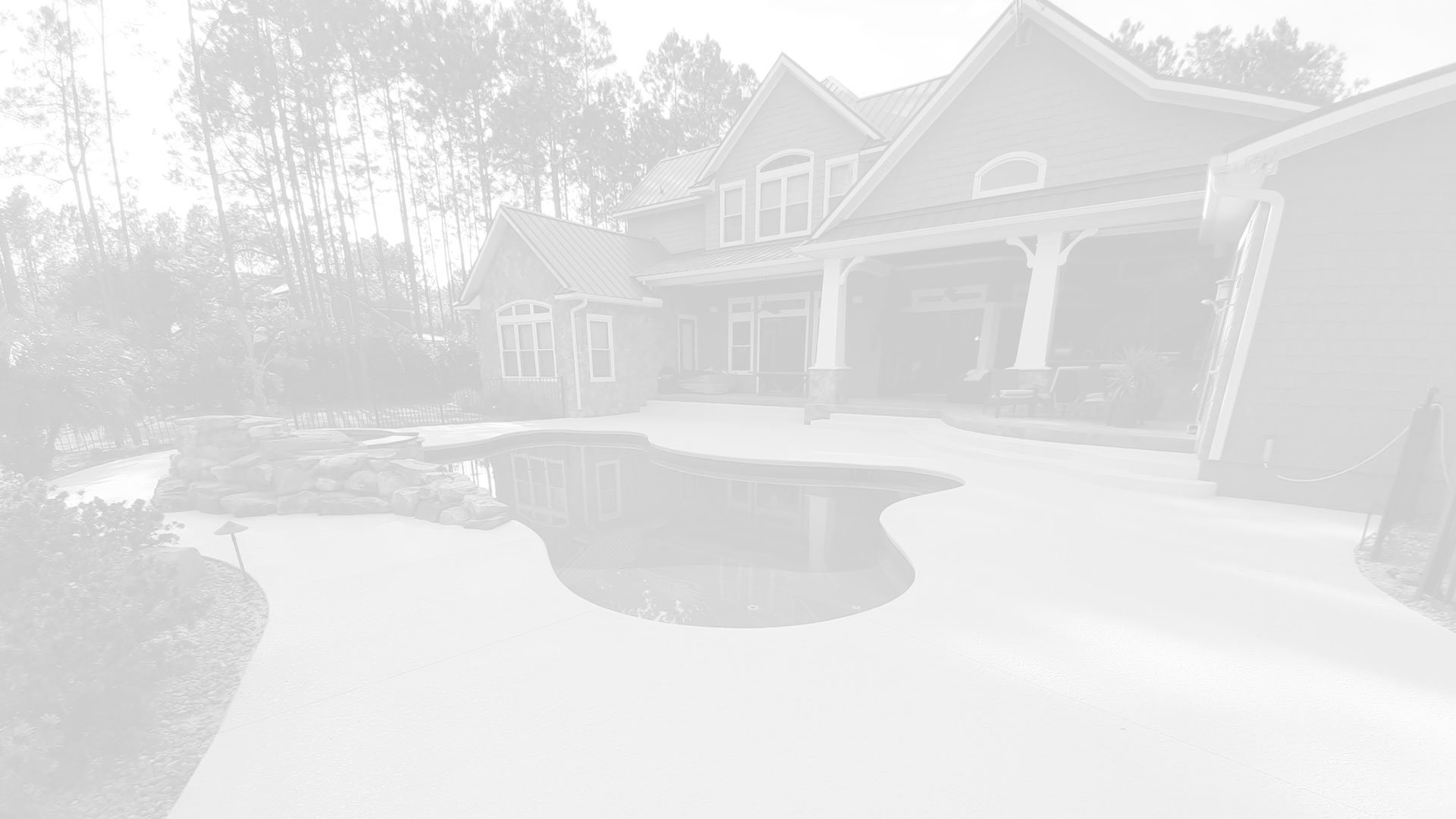
Why Florida Pool Decks Need Professional Cleaning Once or Twice a Year
Published: April 24, 2026
Most Jacksonville homeowners clean their pool deck when it starts to look bad. By that point, algae has usually been embedded for months, the sealer is under stress, and what could have been a straightforward annual wash has turned into a more involved restoration project.
In Northeast Florida, pool decks don't get a slow decline. The heat, humidity, frequent rain, and organic debris that define this climate work fast. A surface that looks fine in March can have visible growth, slippery patches, and fading by July if it hasn't been maintained. Professional cleaning once or twice a year isn't an upsell — it's what keeps a well-built pool deck performing the way it should.
What Does Professional Pool Deck Cleaning Actually Involve?
A professional cleaning removes what a garden hose cannot: embedded algae spores, mold and mildew colonies, mineral deposits from pool water, sunscreen and chemical residue, and the thin organic film that builds up over months on concrete and coated surfaces. Done correctly, it cleans without damaging the surface or degrading the sealer underneath.
The process involves controlled pressure, appropriate chemistry for the surface and coating type, and proper rinsing to remove all loosened material. What gets left behind after a homeowner spray-down is often more than visible — it's biological. Algae and mold spores don't become inactive just because the deck looks dry and clean from a distance.
For professional pool deck washing, the goal isn't just appearance — it's resetting the surface so the sealer can do its job.
Why Jacksonville's Climate Makes Annual Cleaning Non-Negotiable
Jacksonville's heat, year-round humidity, frequent afternoon rain, and heavy tree canopy create near-ideal conditions for algae, mold, and mildew to establish and spread on pool decks quickly. Surfaces that stay damp — especially those under a screen enclosure or shaded by large oaks — can show visible growth within weeks of the last cleaning if conditions are right.
This isn't a surface problem — it's a climate problem. Northeast Florida doesn't have a true dry season long enough to let concrete fully recover between warm, wet stretches. Humidity stays elevated even when it hasn't rained in several days. Spores don't need standing water to germinate. Moisture in the air and on the surface is enough.
Homes near the coast — in Atlantic Beach, Neptune Beach, and Jacksonville Beach — add salt air to the equation. Properties with significant tree coverage in Mandarin, Fleming Island, and St. Johns deal with constant organic debris landing on wet surfaces and staying there. Both conditions accelerate the biological load on a pool deck between cleanings.
For a deeper look at how algae, mold, and mildew spread on pool decks and concrete surfaces in Jacksonville, the short version is that these aren't occasional problems — they're active and ongoing in this climate.
What Happens When Pool Deck Cleaning Is Skipped
Skipping annual cleaning doesn't just leave a pool deck looking neglected — it starts a chain of accelerating damage that becomes more expensive to reverse the longer it runs.
Here's what we typically see on pool decks that have gone two or more years without professional attention:
- Sealer breakdown at the surface. Algae and mold hold moisture against the coating and accelerate UV degradation. What should last 3–5+ years with regular maintenance can fail significantly earlier without it.
- Slippery surfaces near the pool edge. Wet algae on concrete or a coated deck is a genuine slip hazard. This is one of the first things homeowners mention when they finally call — they noticed someone almost go down near the steps or along the edge.
- Staining that won't lift. Green, black, and rust-colored staining becomes harder to remove the longer it's left. Some staining, especially tannin from oak leaves, can require more aggressive treatment after extended exposure.
- Concrete degradation underneath. When sealer breaks down and moisture penetrates, the concrete below is no longer protected from pool chemicals, rain, and ground movement. This is when cracks appear and worsen faster than they should.
What starts as a maintenance visit turns into a repair conversation. In most cases, the homeowner knew the deck needed attention but kept putting it off. That pattern is very common, and it's exactly what regular annual cleaning prevents.
How Professional Cleaning Protects Your Sealer
Sealer is the primary protective layer between a pool deck and everything that works against it — UV exposure, pool water chemistry, foot traffic, and biological growth. Keeping the surface clean is the single most effective way to help that sealer last.
Organic material sitting on a sealed surface doesn't just look bad. It holds moisture, creates an acidic microenvironment, and allows biological roots to work into the surface over time. Pool chemicals splashed on a dirty deck interact differently than they do on a clean one. The combination adds up.
Professional cleaning removes these stressors before they accumulate into real damage. When a pool deck is cleaned annually, the sealer maintains more of its protective integrity across its full service life — which means pool deck sealing intervals can stay closer to the 3–5+ year range rather than compressing down due to accelerated wear.
For the full picture on why resealing your pool deck every 3–5+ years protects your investment in Jacksonville, the relationship between cleaning and sealer longevity is one of the most practical points in that article.
Signs Your Pool Deck Is Overdue for a Cleaning
Most of these are visible on a dry surface in good light. Some you'll feel underfoot before you see them clearly.
- Green or black discoloration in the joints, along the edges, or spreading from shaded areas
- Slippery texture anywhere on the surface, even when the area appears dry
- Faded or uneven color that wasn't there a year or two ago
- Leaf and debris staining that doesn't rinse away
- White or chalky residue from pool water splashout and mineral deposits
- A film or sheen visible when the deck is wet that doesn't clear after rain
- Persistent organic smell near the pool edge or screen enclosure corners
If two or more of these are present, the deck is past due for professional attention. If you're also noticing the sealer looks dull, chalky, or water is no longer beading on the surface, a cleaning evaluation and sealer inspection are both worth scheduling at the same time.
Frequently Asked Questions
Once a year is the baseline for most Northeast Florida pool decks. Twice a year is reasonable for properties with heavy tree coverage, screen enclosures that trap moisture and debris, or decks that get heavy use. Jacksonville's climate doesn't give surfaces much recovery time between warm, wet seasons.
A consumer pressure washer can remove surface debris, but it won't address embedded algae, mold, and mildew the way professional equipment and chemistry will. Incorrect pressure settings can also damage coatings and drive water into cracks. For basic rinsing between visits, homeowner cleaning is fine — as a replacement for professional service, it falls short.
Not when done correctly. Professional cleaning is calibrated to the surface and coating type. The goal is to clean the sealer, not remove it. In fact, removing biological load regularly extends sealer life — the opposite of stripping it.
Spring and fall are the most common scheduling windows — before the heaviest use season and again after summer. That said, pool decks in this climate need attention year-round. If the deck is visibly growing algae or showing slip risk, it shouldn't wait for a seasonal slot.
Cleaning addresses surface-level biological growth, staining, and buildup. If the coating itself is peeling, flaking, or delaminating — or if the concrete beneath is cracking significantly — that's a resurfacing or repair conversation, not a cleaning one. A site evaluation makes that distinction clearly before any work is scheduled.
Ready for an Evaluation?
If your pool deck is showing growth, staining, or starting to feel slippery underfoot, it's worth having someone take a look before it goes further. Residential Concrete offers free evaluations throughout Jacksonville and the surrounding Northeast Florida area.
904-364-7153 or use the Contact Us button below to schedule a time that works for you.